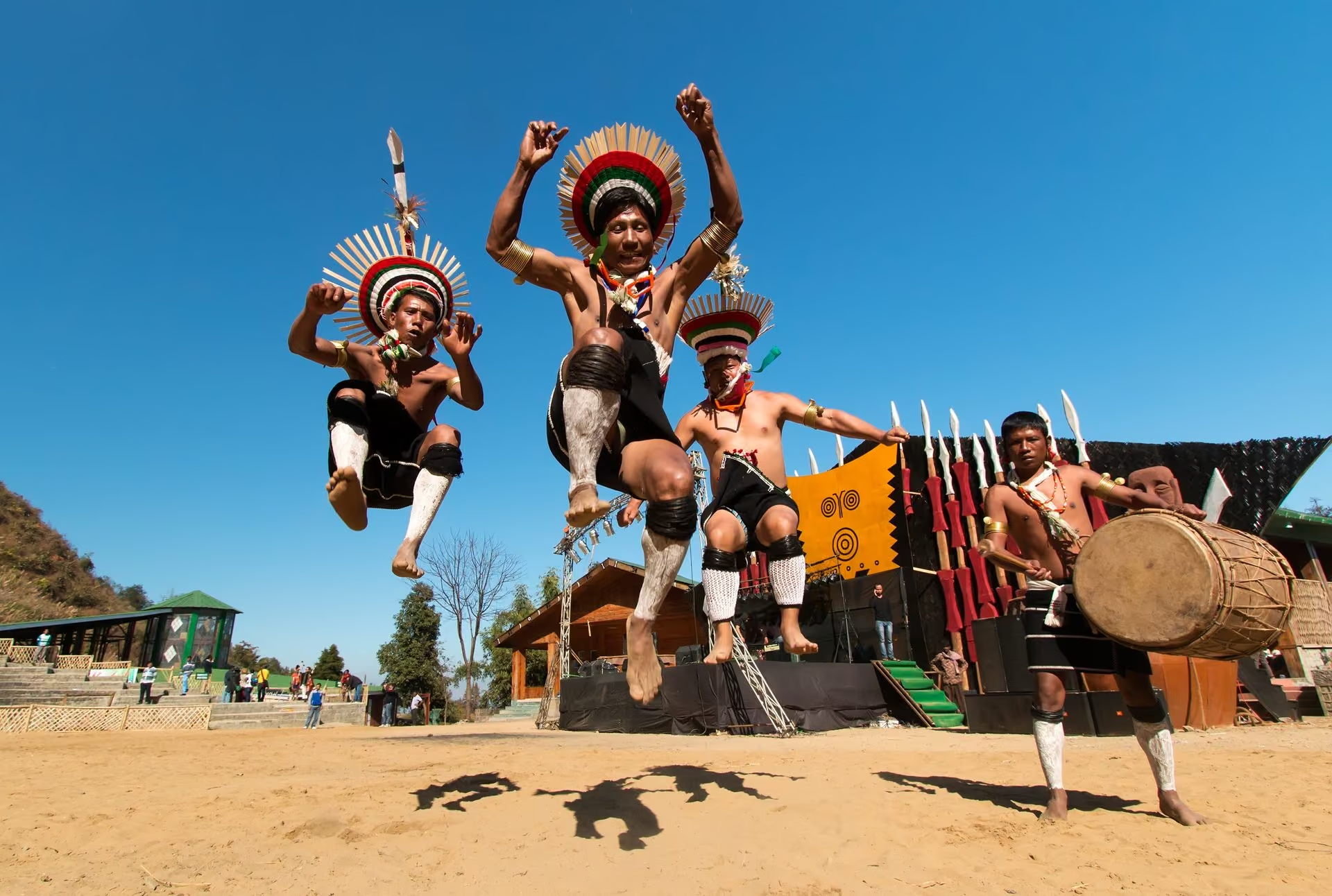
Hornbill Festival
Also known as: Festival of Festivals, Hornbill Festival Nagaland, Kisama Hornbill Festival
Nagaland's ten-day cultural festival at Kisama Heritage Village near Kohima, bringing the Naga tribes together each 1–10 December for dance, crafts, food, sports and music.
Location
Kisama Naga Heritage Village, near Kohima, Nagaland
Duration
10 days
Month (AD)
December
Highlights
Tribal morungs, war dances and folk songs, traditional archery and Naga wrestling, Naga King Chilli eating contest, handloom and craft stalls, Hornbill Music Festival and International Rock Contest, World War II museum, night carnival.
Tips for Visitors
Book Kohima accommodation months ahead, as rooms fill up for the ten days. Get your Inner Line Permit (Indian nationals) or e-FRRO registration (foreign nationals) before travelling. Arrive at Kisama early for parking and a good arena seat, and dress in warm layers because December mornings and evenings in the Naga hills are cold. Ask before photographing people at the morungs, and treat the village as a living cultural space rather than a stage.
The Hornbill Festival is Nagaland's annual showcase of Naga culture, held every year from 1 to 10 December at the Naga Heritage Village in Kisama, about 12 km from the state capital Kohima. Nicknamed the "Festival of Festivals", it gathers the state's tribes in one place for ten days of dance, song, crafts, food, sport and music. It is named after the hornbill, the big-billed forest bird that appears in the folklore of most Naga tribes as a symbol of boldness and grandeur.
Origins and history
Unlike the harvest and seasonal rites that each Naga tribe keeps in its own villages, the Hornbill Festival is a modern creation. The Government of Nagaland conceived it in 2000 as a tourism and cultural-promotion event, timed to coincide with Nagaland Statehood Day on 1 December (Nagaland became the 16th state of the Indian Union in 1963). The idea was to bring the many Naga communities together for inter-tribal exchange while preserving and presenting their heritage. The first editions were held at the Kohima Local Ground; from 2003 the festival moved to its permanent home at Kisama.
Kisama is a purpose-built heritage complex. Its name combines two village names, Kigwema (Ki) and Phesama (Sa), with "ma", meaning village, because it stands on land belonging to those villages. The complex was built to protect and display Naga ethnic heritage in one managed setting.
What happens, day by day
The festival opens on 1 December with an inauguration ceremony, usually attended by state and national dignitaries, and runs for ten days. There is no single climax; instead the programme repeats and rotates, so any day offers a full experience.
- Morungs. At the heart of the village are the morungs, traditional youth dormitories, built in the architectural styles of the different Naga tribes. Each is staffed by members of its community, who cook traditional food, show crafts and weapons, and perform songs and dances in their own idiom.
- Arena performances. Each day tribal troupes take the main arena in full costume, with war dances, folk songs, and ceremonial displays.
- Sports and indigenous games. Traditional archery, Naga wrestling and indigenous games are staged, along with open contests such as the Naga King Chilli and pineapple eating competitions.
- Crafts and food. Stalls sell handlooms and handicrafts, bamboo and wood work, herbal medicine, and a wide range of Naga food; there are also flower shows and a bamboo-themed carnival.
- Hornbill Music Festival. Evening concerts and the Hornbill International Rock Contest run alongside the cultural programme, giving the festival its contemporary side. Fashion shows and a beauty contest are part of the line-up.
- World War II connections. The heritage complex houses a World War II museum, and a WWII rally is listed among the festival's activities, recalling the Battle of Kohima fought in this region in 1944.
- Day trips. Village walks, mountain biking, and day hikes to Dzukou Valley are offered as side programmes.
Where and how to watch
Kisama is about 12 km from Kohima, and most visitors stay in Kohima and travel out each day. The nearest airport is at Dimapur, about 74 km away according to the Ministry of Tourism's event listing. Daytime programmes run in the arena and at the morungs, while the concerts and night carnival come after dark.
Permits
Nagaland is a restricted-entry state. Indian domestic tourists need an Inner Line Permit (ILP) obtained online from the state ILP portal; foreign visitors must register for a Protected Area Permit through the e-FRRO portal (the Protected Area Permit relaxation was withdrawn from Nagaland in March 2025, according to the Dimapur district administration). Apply well before travel, and re-check the rules on the official sites.